THE ALCHEMISTS - When matter gives life
Stepping into the Hall of the Caryatids at the Palazzo Reale in Milan is an awe-inspiring experience.
Originally called the Hall of Mirrors and built in the second half of the 18th century, it was a venue for balls and celebrations in honour of kings, emperors, and presidents. The vaulted ceiling was frescoed and surrounded by stucco work.
In 1919, the palace passed from the ownership of the House of Savoy to the Italian State. Unfortunately in 1943, due to bombing, the east wing of the building and the attics of all the rooms were damaged or caught fire, as was the case with this room. Its ceiling collapsed, destroying the marble floor. The stuccoes burned, thus disfiguring the Caryatids. It was in their honour, as they were the main victims of the destruction, that the room was named. After the war, the ceiling and floor were rebuilt, but the room stayed as it was, with its stucco speaking to us without eyes or with deformed faces, reminding us of the destructive force of every war, even on works of art.
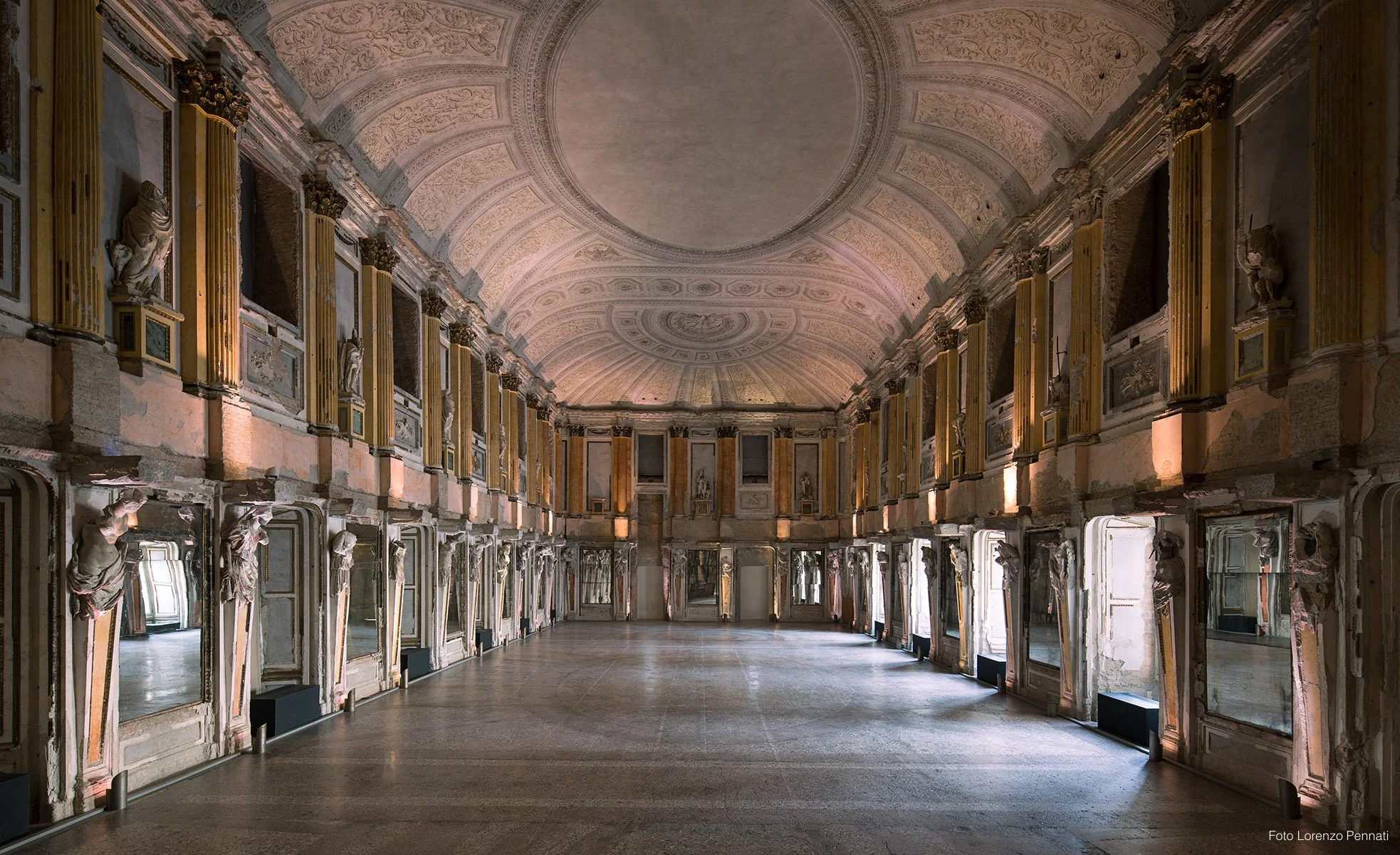
The hall remains, however, a vast space, with a soaring ceiling and long windows through which light filters, bringing everything around it to stand out. There could be no more fitting location for Anselm Kiefer’s works on display in the exhibition The Alchemists. These are imposing works of great impact. Matter seems to almost spill out of the forty large canvases, engaging in a dialogue with the dramatic beauty of this place.
Kiefer, a multimedia artist and, in some respects, a controversial figure, was born on 8 March 1945 in Donaueschingen. He made a name for himself with provocative works that directly addressed Germany’s Nazi past, a subject that was still rarely discussed publicly at the time. He became one of the most important contemporary artists thanks to large-scale works created using materials such as lead, straw and ash, through which he reflects on history, memory and European culture. Throughout his career, he has exhibited in many museums and at major international events, including the Venice Biennale. And it is above all in Italy that the German artist has found fertile ground for several projects of great significance.
As impossible as it is to define art, as much as it continually eludes our understanding, one thing is certain: the man I am is incapable of living without art. This is easy to say and yet it is an absolute dependence. (Anselm Kiefer)
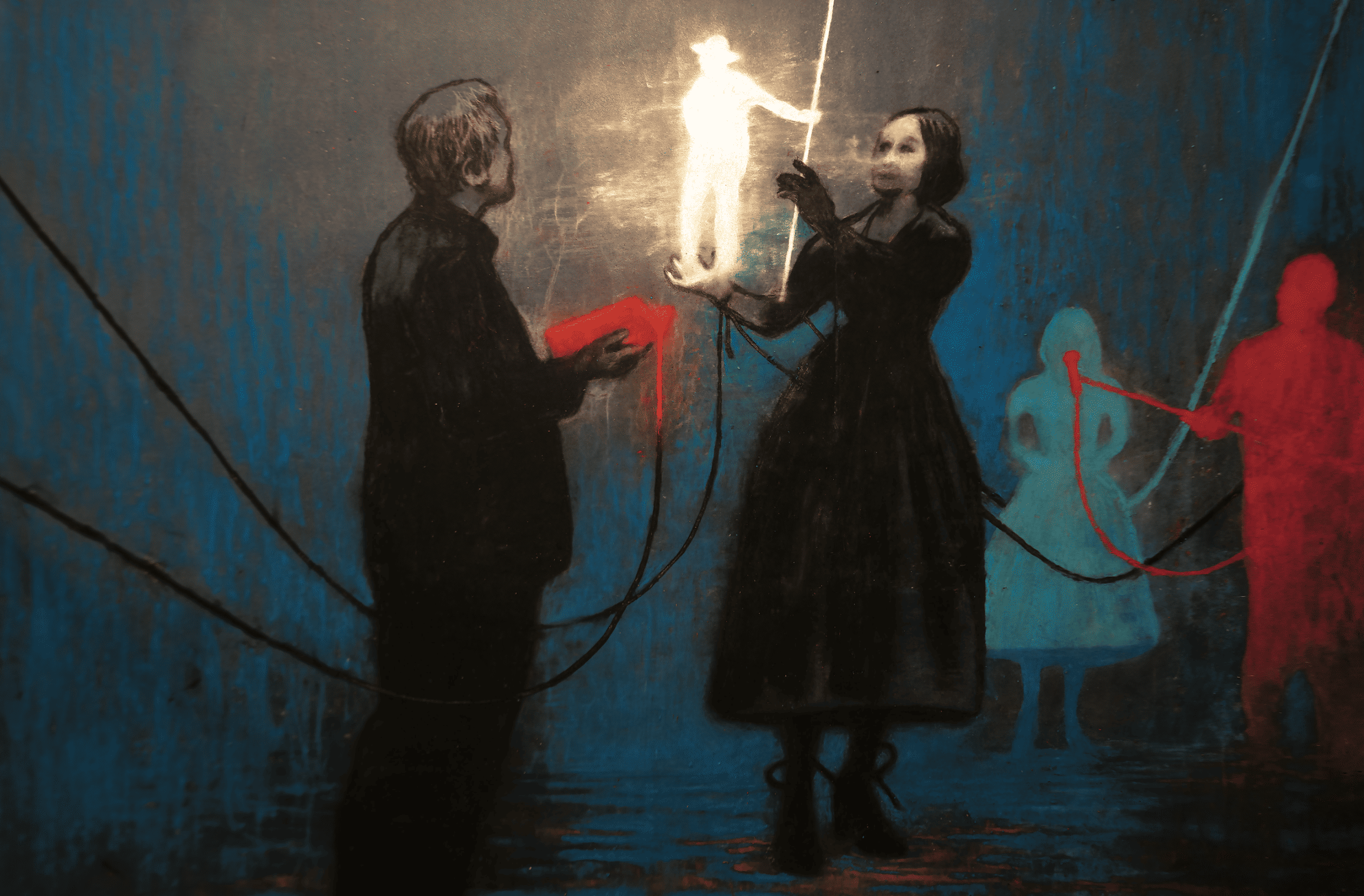
But who are The Alchemists? Caterina Sforza – who emerges from a rose-quartz background – is the artist’s link to Milan: a scientist and military leader, she wrote a manuscript containing over 400 recipes, including medicines and alchemical formulas. Like her, the other women depicted here, who lived between the Middle Ages and the late 18th century, served as a bridge between ancestral alchemical knowledge rooted in nature and its cycles, and its practical application.
Despite the prejudices and limitations of the eras in which they lived, they were courageous figures, free to experiment with their skills (medicine, botany, pharmacy, astrology, cosmetics). People turned to them precisely because they were women, and thus creators and custodians of the mystery of life. Mocked, accused of witchcraft, persecuted, condemned, burnt at the stake, or subjected to ‘erasure’, they simultaneously contributed to the birth of modern science. In their hands, matter was transformed, infused, or distilled.
One cannot help but be struck by the scale of these works (many of which are over five metres high and more than two metres wide), by the colours, by the contrast between darkness and light, and by the gold pigments that characterise them all and are enhanced by the sunlight.
I was captivated by one of the first alchemists to appear before visitors, staring at them with a scrutinising gaze and a branch with flowers and leaves, made of clay and steel, sprouting from her head: Sophie Elisabeth von Clermont, whose name may refer to Leona Constantia, author of an alchemical treatise promising a clear explanation of the preparation of the philosopher’s stone.
I then paused before the figure of Anne Marie Ziegler, a German alchemist accused of murder and condemned to be burned at the stake for her crimes: with a terrified face and her leg and foot thrust forward, she seems literally to be fleeing from the painting.
Martine de Bertereau, a pioneer of French mineralogy, dressed here in white with her arms raised towards the sky, resembles – instead – an angel on the verge of ascension.
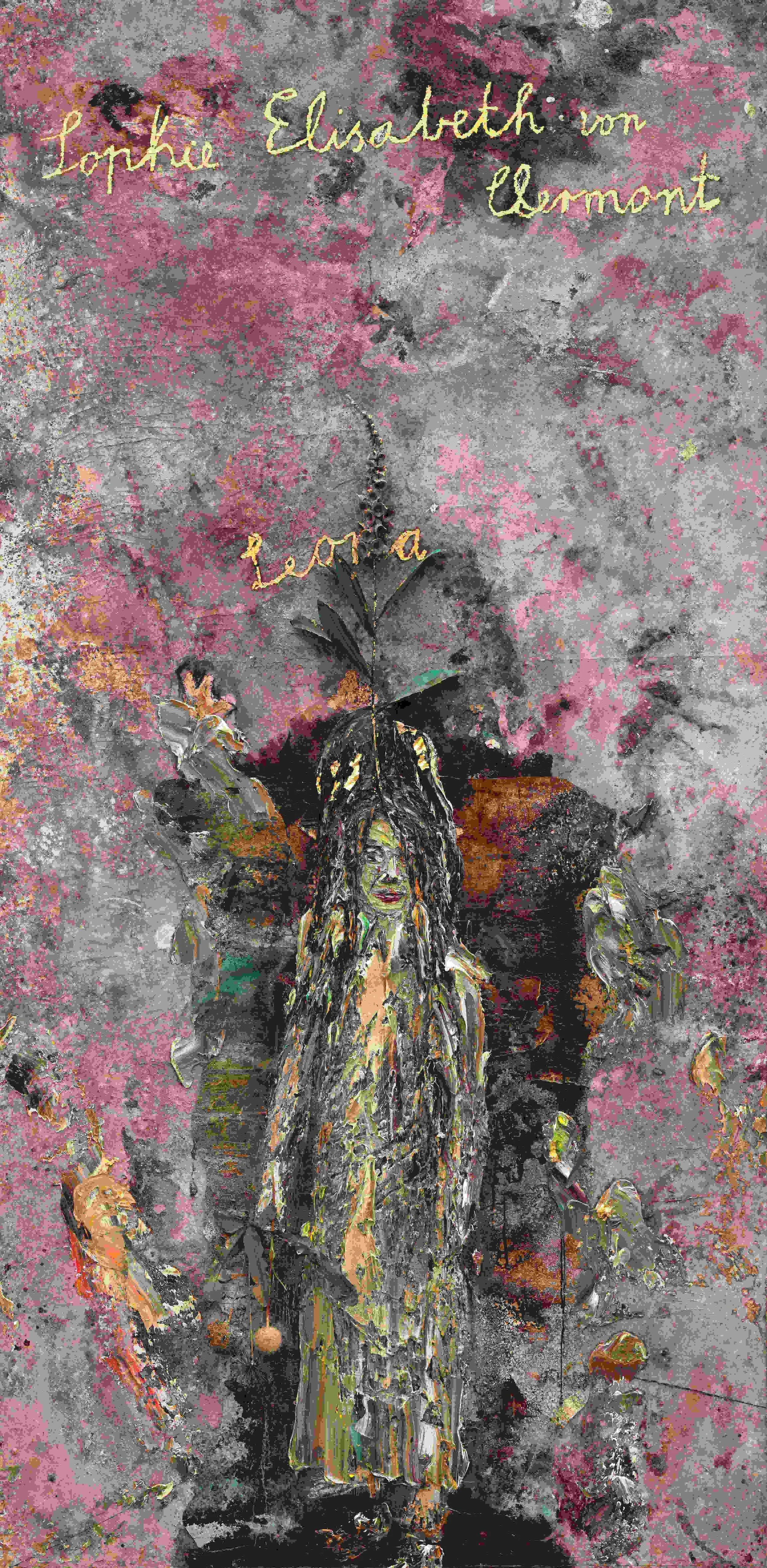
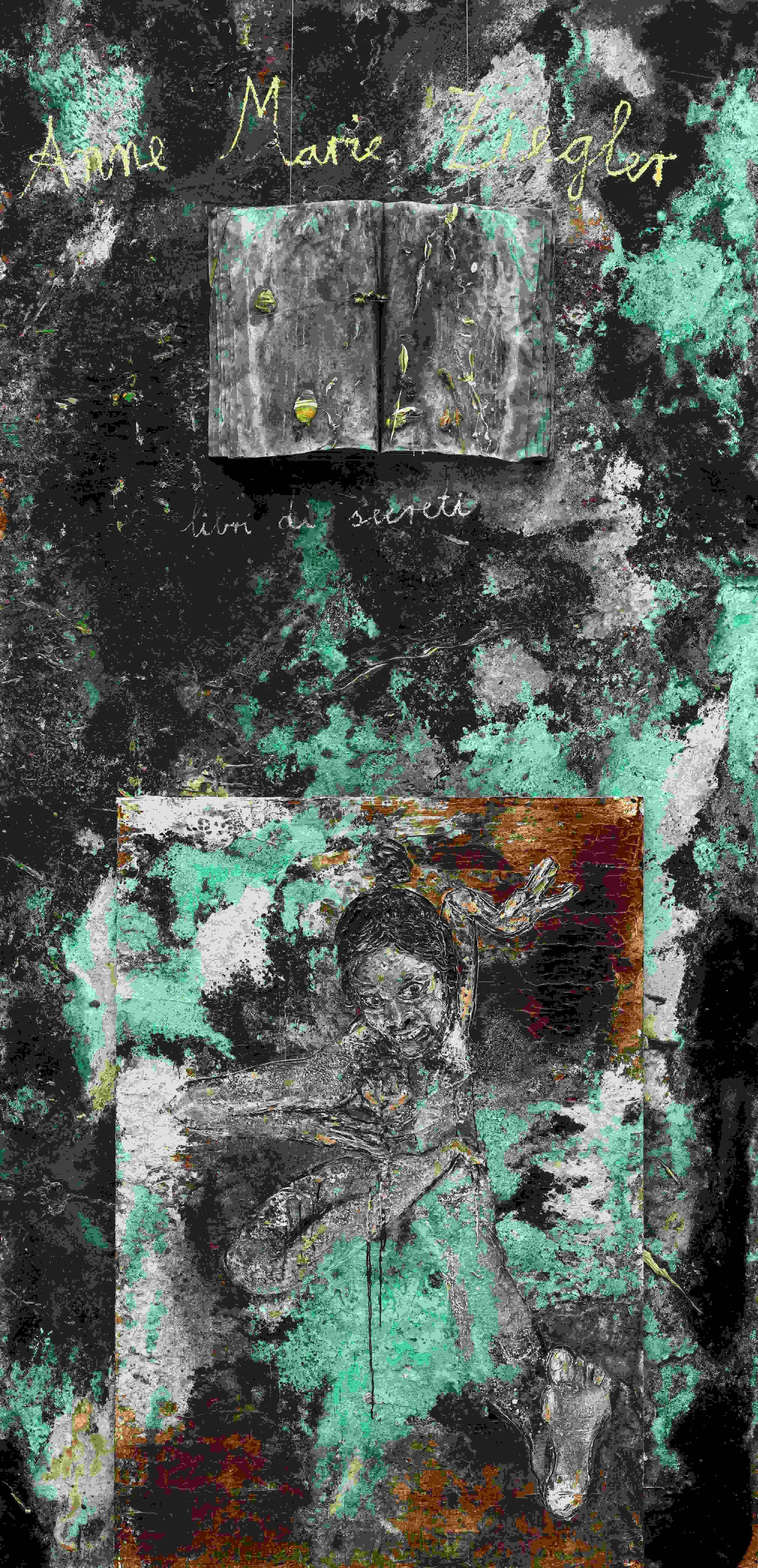
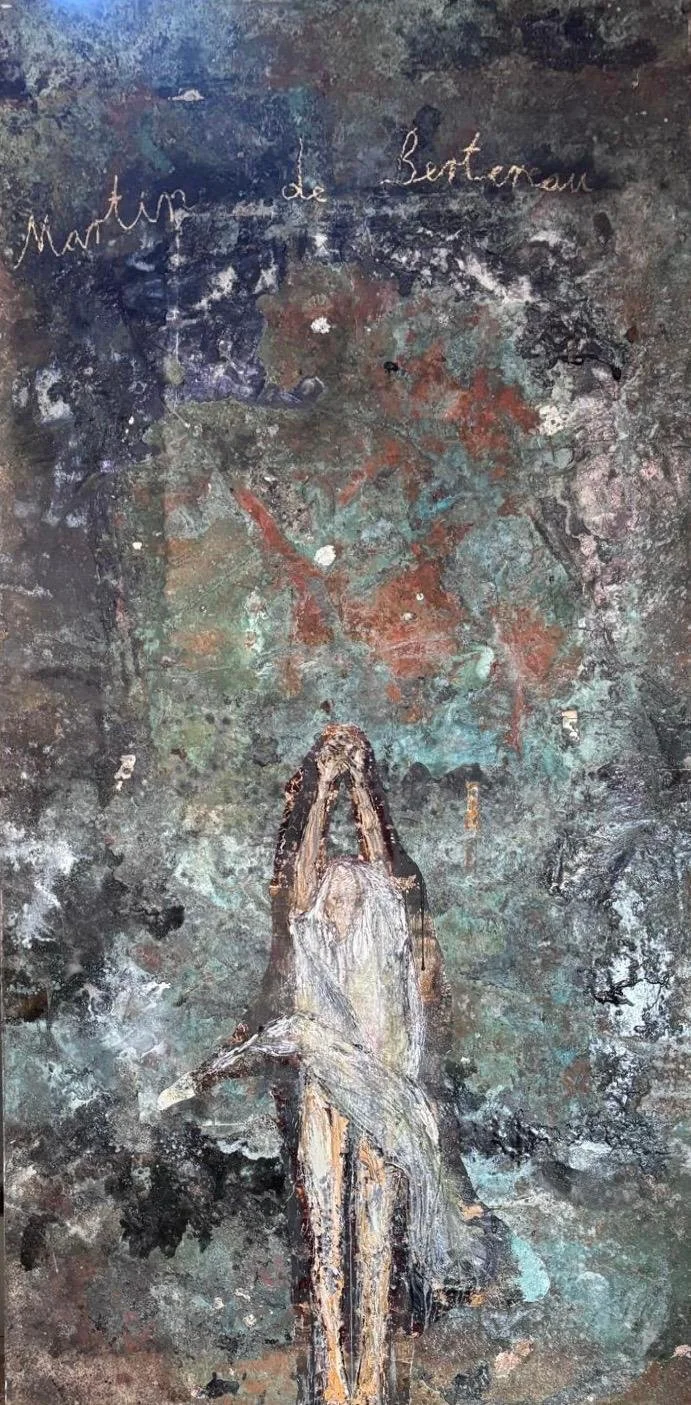
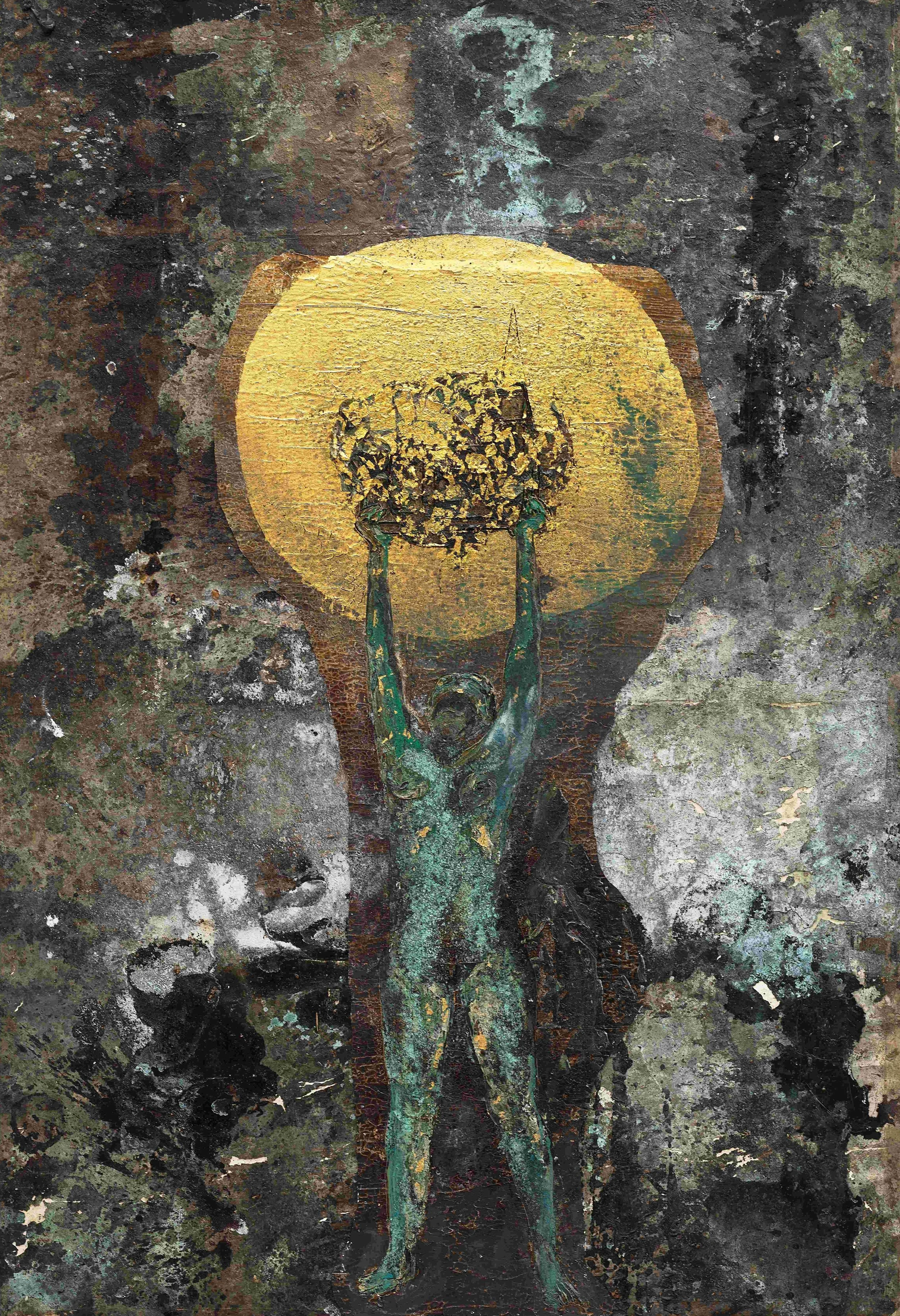
We move from figures with defined contours to women who are almost one with the painting matter. The colours range from pitch black to a greenish blue, which is created through the process of electrolysis; from shades of grey to brown, as in the case of Caterina Sforza, to gold – the element present in all paintings – which represents redemption, the ascent from the underworld towards an eternal dimension.
And it is gold, still, which serves as the overall backdrop and dominates the smaller works found in another area of the room, from which dark three-dimensional faces, depictions of statues and female figures in various poses emerge.
One of them is Elizabeth Grey, the granddaughter of the witch Elizabeth Woodville, whose son was commonly known as the “Wizard Earl” for his fascination with alchemy, metallurgy, and ancient magic. She appears here almost as a mystical figure from the East, wearing a sari-like dress and carrying a container with gold on her head.
Many of these alchemists are unknown to us, but Kiefer has inscribed their names on his works, bringing back to light what has long remained in the darkness of collective memory. By creating, transforming, and combining oil, acrylic, shellac, gold leaf, electrolysis sediments, lead, cotton, clay, silicone, charcoal and organic elements,
Kiefer himself becomes the alchemist, the demiurge who shapes and transforms matter, creating ‘something else’, giving form and dignity to these women so that they may live again with us.
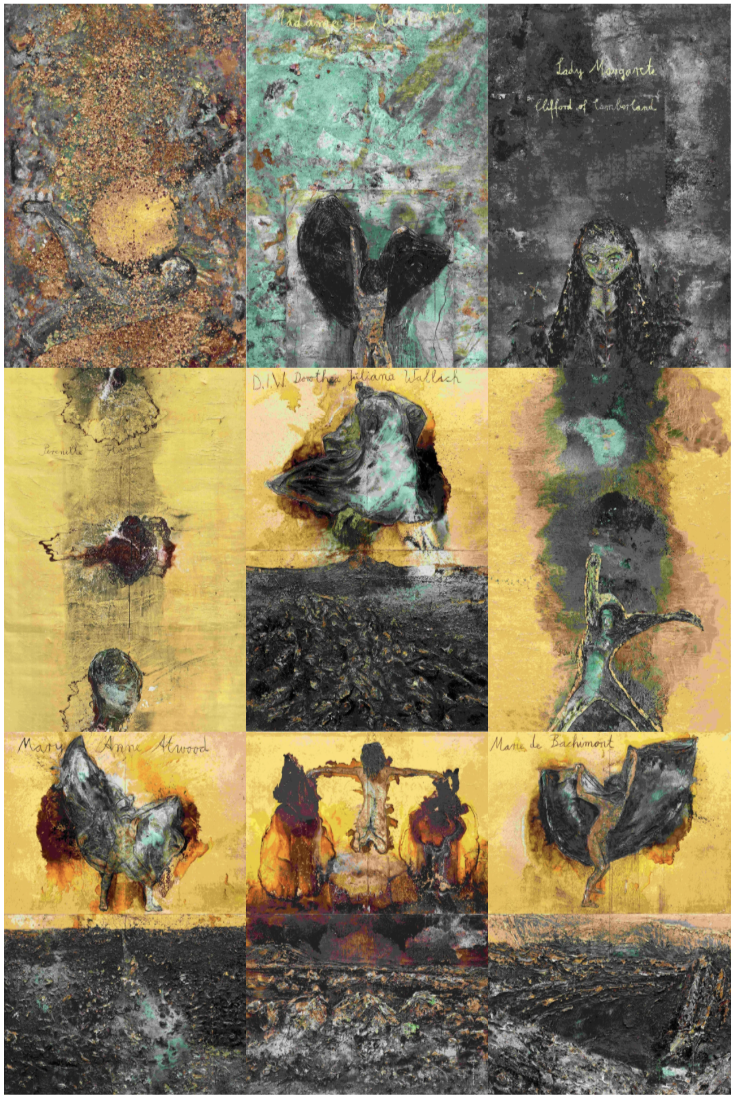
Part of the cultural programme for the Milan-Cortina 2026 Winter Olympic Games, the exhibition Le Alchimiste, curated by Gabriella Belli, will be open until 27 September 2026.
In the cover:
Detail of Sophie Brahe © Anselm Kiefer, photo: Nina Slavcheva
In the article:
Palazzo Reale, Sala delle Cariatidi © Lorenzo Pennati
Caterina Sforza © Anselm Kiefer, photo: Nina Slavcheva
S.E. von Clermont, A.M. Ziegler © Anselm Kiefer, photos: Nina Slavcheva
M. de Bertereau © Anselm Kiefer, photo: Paola Caronni
Elisabeth Grey © Anselm Kiefer, photo: Nina Slavcheva
Composition:
I. dAragona, M. Martinville, M. Cumberland,
P. Flamel, D.J. Wallich, C. Erculiani,
M.A. Atwood, A.K. Kleopatra, M. deBachimont,
© Anselm Kiefer, photos: Nina Slavcheva
Images courtesy of Palazzo Reale Milan